


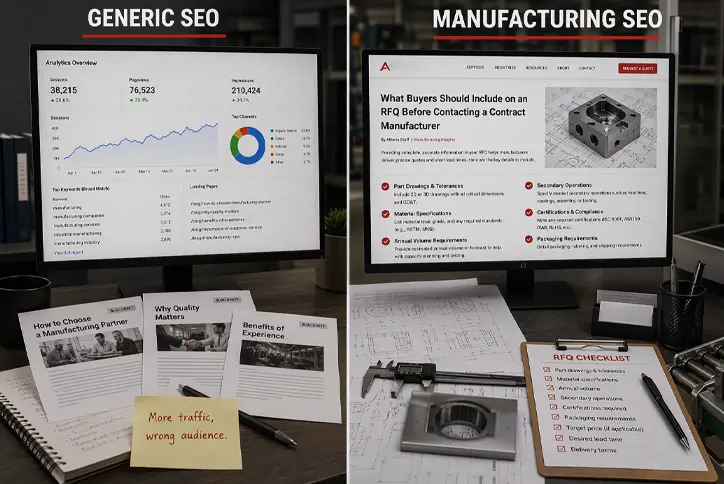
When manufacturers invest in SEO, they expect to see an increase in qualified leads. Often, there is more traffic going to the site, but the conversion rate remains flat. Sometimes the content lacks depth, but often the problem starts much earlier with the SEO strategy itself. SEO for B2B manufacturing requires an understanding of manufacturing processes, industrial buying behavior, how engineers, procurement teams, and OEMs search for suppliers, and the pain points that drive their searches. Without that knowledge, agencies can target the wrong keywords, create content for the wrong audience, and optimize pages that never attract the right prospects.
Search engines have also become better at recognizing expertise. AI-powered search experiences summarize information from sources they consider technically accurate and authoritative. Manufacturers that combine industry knowledge with sound SEO practices are better positioned to earn visibility and qualified leads.
SEO for B2B Manufacturing Starts With Understanding the Buyer
Keyword research tools show search volume, competition, and related phrases. They do not explain who is searching or why. Several audiences may use similar terminology while having completely different goals. Engineers may be looking for a supplier. Plant managers may be researching equipment. Students may be trying to understand a manufacturing process. Optimizing content for the wrong audience can increase traffic without producing qualified leads.
Consider an injection molding company that manufactures custom plastic parts. A general SEO strategy might recommend targeting “injection molding machine” because it has significant search volume. In reality, that search is more likely to come from someone comparing equipment, researching machine specifications, looking for maintenance information, or purchasing machinery. Those visitors are unlikely to become customers of a custom injection molder.
Another example is keywords that aren’t relevant to a specific customer, such as “injection mold making” when the injection molder doesn’t make molds in-house. Someone searching for this term is interested in how molds are made, and likely not a potential customer.
The same pattern is seen across industries. A control panel builder is unlikely to generate qualified leads by targeting “PLC programming software.” Buyers looking for custom panels are more likely to search for “industrial control panel builder”, “UL 508A panel shop”, or “custom control panels”. A sheet metal fabricator benefits more from ranking for “precision sheet metal fabrication” or “custom metal enclosures” rather than “laser cutting machine”.
With that said, it is also necessary to understand not only how the buyer searches, but also the terminology they may use. The terminology may not be industry standard. A classic example is the large number of people who refer to shipping boxes as cardboard boxes. It may be necessary to include common buyer language, even if it is not technically correct. This can be done in a way that demonstrates it was done purposefully and not out of a lack of technical knowledge.
A general SEO agency may start with keywords and their associated volumes. An agency with industry expertise starts by asking different questions:
- What does the company actually sell?
- Who is its ideal customer?
- Who signs the purchase order?
- What problems are they trying to solve?
- What is important to them in a vendor?
- What is unique about this company or industry (specific terminology, unique services, etc.)
- Is this search likely to come from a prospect or someone looking for equipment, training, or another unrelated purpose?
In short, SEO for B2B manufacturing begins by understanding what the company sells, who makes the purchasing decision, and how those buyers describe their needs.
Read also, Three Steps to Generating Value Messaging That Resonates
Technical Accuracy and Depth Show Experience and Expertise
The framework that Google uses to evaluate the quality and credibility of a website and a critical component of its Search Quality Rater Guidelines (QRG), is called E-E-A-T, which stands for Experience, Expertise, Authoritativeness, and Trustworthiness. Google’s QRG does not directly affect the search engine results page (SERP) ranking, but it influences how Google evaluates the effectiveness of its ranking systems and what those systems are designed to reward. Search engines increasingly favor content that demonstrates real-world experience, technical expertise, and a clear understanding of the topic.
This presents a challenge for manufacturers who hire agencies that lack industry knowledge. Creating content that genuinely demonstrates expertise is difficult to produce because it requires understanding manufacturing processes, industry terminology, quality standards, production methods, buyer concerns, and the questions prospects ask during the purchasing process.
An article about injection molding should explain material selection, tooling considerations, part design constraints, production volumes, and common manufacturing challenges. A page about industrial control panels should accurately discuss UL certifications, component selection, application requirements, and integration considerations. A contract packaging company should be able to explain packaging formats, production scalability, quality controls, and operational requirements. These details help prospects evaluate suppliers and help search engines recognize that the content was created by individuals with relevant knowledge and experience.
Manufacturing buyers are often engineers, operations leaders, procurement professionals, and technical decision-makers. They can quickly identify content that is generic or inaccurate, or written by someone unfamiliar with the industry, and will quickly disqualify them.
Search engines are also less likely to reward generic manufacturing content that repeats the same advice found across competing websites. Content with firsthand detail, specific technical answers, and original insight is more likely to earn visibility and trust over time.
What General and B2C Agencies Often Get Wrong
Many SEO mistakes on manufacturing websites come from applying consumer marketing habits to a technical B2B sales process. An agency that works with primarily B2C clients may focus on broad traffic, high-volume keywords, short product-style copy, campaign language, and quick calls to action. That approach can work when the buying decision is simple, emotional, or price-driven. It often fails when the buyer needs to evaluate capabilities, tolerances, certifications, production fit, risk, and supplier reliability before starting a conversation.
In addition to the keyword intent issues discussed earlier, general agencies may also misinterpret what constitutes useful content in a manufacturing sale. A keyword can be relevant on paper and still lead to weak content if the page does not help a buyer evaluate fit. The issue may not be which phrase the agency targets, but whether the content answers the questions that come before an RFQ: Can this supplier make the part? Do they work with the right materials? Can they support the required volume, standards, and timeline? Do they understand the application well enough to reduce risk?
Another mistake is writing thin content around surface-level differentiators. B2C and general content often lean on convenience, speed, customer service, and brand preference. Search engines are also less likely to reward generic manufacturing content that repeats the same advice found across competing websites. Content with firsthand detail, specific technical answers, and original insight is more likely to earn visibility and trust over time. For example, “How to Choose an Electronic Manufacturing Company” is likely to offer the same broad advice as competitor sites. “Why Engineering Support Matters More Than Unit Price When Choosing an Electronic Manufacturing Company” uses the same keyword (electronic manufacturing company) but is stronger because it focuses on a specific buying decision. If the page says the same things competitors say, it does not help the buyer narrow the supplier list.
The same is true for capability accuracy. As noted earlier, inaccurate or generic manufacturing content can damage credibility. The additional risk with a general or B2C agency is that the writer may not recognize when a phrase implies a capability the company lacks. Terms such as engineering support, in-house tooling, cleanroom production, domestic sourcing, finishing, assembly, or certified production have specific meanings for technical buyers. Used loosely, they can attract poor-fit leads and create problems for the sales team.
When using a general agency, there is a mismatch in priorities. A general agency may measure progress by rankings, impressions, pageviews, and polished copy. A manufacturing company needs the site to support supplier evaluation and lead qualification. If the agency does not understand the sales cycle, the website may look active in analytics reports while producing few useful conversations with buyers who have a real need. Those agencies will consider this a success because client ROI is not a concern.
Read How to Measure SEO ROI for Manufacturing Companies to learn how Athena helps manufacturers forecast SEO ROI.
Work With an SEO Team That Understands Manufacturing
Athena SWC works with manufacturers that need more than traffic from their SEO program. Our team understands how industrial buyers search, what they need to see before contacting a supplier, and how to connect keyword strategy with real business outcomes. We build content around buyer intent, technical accuracy, lead quality, and measurable ROI so manufacturers can attract prospects who fit their capabilities rather than general visitors who are unlikely to convert.
Comments are closed