


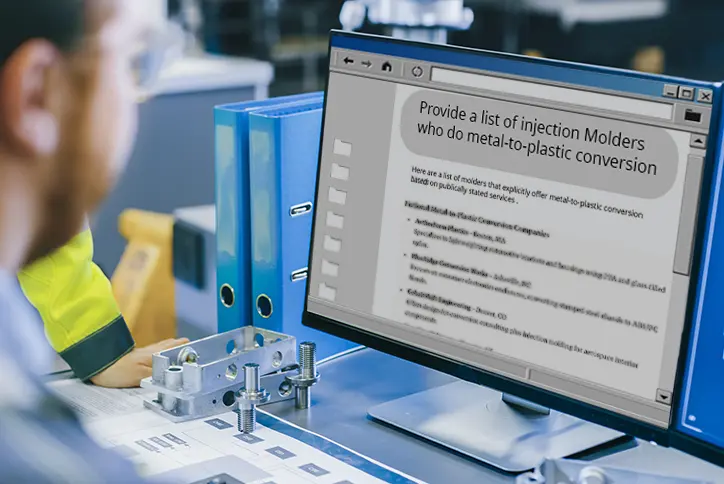
Not that long ago, when looking for a contract manufacturer, buyers or decision-makers would ask for referrals or conduct an online search, compare capabilities and other aspects important to their business, and create a shortlist of companies to contact. Today, ChatGPT, Claude, and other AI platforms can create a shortlist in a matter of seconds. As a result, AI visibility for manufacturers has become critical. A qualified manufacturer may be excluded from consideration if AI fails to find the right information.
What is AI Visibility for Manufacturers?
AI visibility determines whether AI tools and search engines can find, understand, and present a manufacturer as a relevant option when buyers research suppliers. It is not the same as brand awareness or traditional search ranking. A manufacturer may be well-known in its region or industry and still be difficult for AI systems to classify if its website is not configured properly and does not clearly state what it makes, the processes it offers, the materials it works with, the industries it serves, and the requirements it can support.
Recent data shows that 55% of B2B buyers use AI tools to compare vendors, and 47% build business cases before contacting vendors. When a buyer asks an AI tool to find suppliers for a specific process, material, part type, certification, or production need, the tool matches that request to available information. If the manufacturer’s digital footprint is vague, inconsistent, blocked from crawling, or built on generic claims, the company may be left out even if it offers the best solution.
That same research showed that company website traffic was down by 10% to 40% as research migrated from traditional search engines to AI. Manufacturers that are not considering answer engine optimization (AEO) and generative engine optimization (GEO) may see an impact on qualified website traffic, RFQ volume, and early-stage buyer visibility as more supplier research occurs within AI-generated results rather than traditional search listings.
How are Buyers Using AI During Supplier Research?
Buyers have embraced AI because it shortens the early research process. Instead of opening 10 tabs, scanning websites, and manually saving supplier names, they can ask a direct question and receive a filtered answer. A buyer might ask for U.S.-based manufacturers that work with a specific material, suppliers with a certain certification, or companies that support a defined production need.
AI is only one tool used for creating a shortlist of vendors. Supplier qualification still requires engineering review, technical conversations, capacity checks, pricing, and risk evaluation. It is the first pass that is being changed by AI, and the consequences are significant. It can shape which companies are seen, compared, and brought into the next stage. For a company with a weak online presence, this creates a real issue.
What Do AI Tools Need to Understand About a Manufacturer?
AI tools need sufficient context about a manufacturer to understand if it is relevant when a question is asked. For example, a box manufacturer that lists “retail packaging” provides less useful information than one that explains the materials, processes, box types, printing capabilities, and other services, such as taping, gluing, stapling, fulfillment, and warehousing. A contract manufacturer that names the sectors it supports, the standards it works within, and the project types that fit its operation gives AI and buyers a clearer basis for comparison.
Specificity is important when AI systems are trying to connect a question to an answer. If the buyer’s question includes an industry, certification, process, material, part type, tolerance, or location, the manufacturer’s content needs to make those connections visible in plain text.
Information that AI looks for includes:
- Online Presence and Industry Credibility: Showcasing associations, certifications, and memberships builds trust and demonstrates industry standards.
- Demonstrating Capabilities and Capacity: Provide detailed equipment lists, facility visuals, and technical specs to prove your operational capacity.
- Pricing and RFQ Variables: Explain quote drivers such as materials, production volume, tooling, tolerances, finishing, lead time, and documentation requirements so buyers understand what affects cost and project fit.
- Project Fit Criteria: Clarify ideal project types, production volumes, part complexity, material requirements, tolerance needs, and any work that is not a strong fit.
- Engineering and Risk Support: Identify technical review, manufacturability feedback, supply chain controls, traceability, corrective action processes, and production transition support.
- Industry Served: Listing industries served, job samples, and quantities clarifies your experience and production limits.
- Long-term Relationship Indicators: Highlight delivery performance, safety records, and zero-defect initiatives to reassure buyers of reliability.
- Supplier Qualification Attributes: Promote green practices, ownership diversity, and “Made in USA” status to differentiate your business.
- Industry Leadership: Use blogs, news, ebooks, press releases, and white papers to establish thought leadership and unique value.
- Contact Information: Clearly list key personnel, locations, and contact details to facilitate easy communication and onsite visits.
Technical SEO, AEO, and GEO Factors That Affect AI Visibility
Content quality is only part of the issue. AI visibility also depends on whether search engines and AI systems can access, parse, and connect the information on the site. This is where SEO, AEO, and GEO overlap.
SEO is the foundation for AI access as it helps search engines find and index pages. Implementing GEO and AEO practices builds on SEO and the manufacturers’ existing content that clearly explains their capabilities, processes, and expertise online. A manufacturer’s site should have a clear page structure, crawlable text, descriptive headings, a heading tag hierarchy (h1, h2, h3), and internal links that show how capabilities, industries, applications, and contact paths relate to each other. Important information should never exist solely in images, downloadable PDFs, or interactive elements that search engines may not consistently process.
Structured data is a way of labeling website content so search engines and AI systems can understand what the information represents, rather than just reading the words on the page. Schema markup is one common code used for structured data. It can identify a company as an organization, define a service, label an article, or identify FAQ content, making the relationship between the page, the business, and the information clearer. Structured data will not fix vague content, but schema markup can reinforce strong content that already explains the manufacturer’s capabilities, industries, locations, and buyer-relevant information.
Related Reading:
- Understanding AEO/GEO for Manufacturers provides an in-depth look at what AEO and GEO are and how they compare.
- SEO For B2B Manufacturing: Why Manufacturing SEO Fails Without Industry Expertise explains how working with an agency that understands your industry can boost results.
Comments are closed